





Introduction: Urban Regeneration and Towers in Milan — Between Heritage and Modernity
Milan is a city of apparent contrasts that somehow achieve subtle harmony: a medieval historic center, baroque churches, modern art and contemporary skyscrapers that continually reshape the urban fabric. In recent decades, the transformation of industrial and railway districts into new economic and residential hubs has been driven by ambitious urban regeneration projects. Among these, towers and high-density developments — Porta Nuova, CityLife, Piazza Gae Aulenti — have become symbols of a city trying to balance density, public space, architectural quality and sustainability.
Urban regeneration in Milan isn’t just about erecting towers: it involves converting brownfields, creating integrated green spaces (like the Bosco Verticale), rethinking industrial heritage (former Fiera Milano, former Area Falck), and reshaping transport corridors. These interventions have a real impact on everyday life: new shops and addresses, international offices, housing, infrastructure for soft mobility and reinvented public squares. They also prompt both visitors and residents to reflect on how architecture reshapes a neighborhood’s memory and daily use. How do you get around? Where can you relax? Which contemporary landmarks are worth a visit? What are the entry prices, opening hours, and practical tips to make the most of these places?
This article takes you on an urban journey through Milan’s major developments, using specific examples: Torre Velasca, Palazzo Lombardia, Bosco Verticale, UniCredit Tower, CityLife and the Tre Torri. For each site you’ll find exact addresses, typical opening hours, price indications, immersive descriptions and practical tips to plan your visit. The aim is both tourist and professional: to offer a critical and practical reading of how Milan has shaped new public spaces around its towers, blending business, housing and leisure.
Keep in mind that some sites are private complexes or office buildings and public access can be restricted to certain time slots, guided visits, or temporary events. The information in this article is indicative — it’s recommended to check official websites for up-to-date hours and prices before you go. Walk between modernity and history with the addresses below: they’ll tell you how Milan managed to embrace verticality without giving up the art of urban strolling.
Porta Nuova and Piazza Gae Aulenti: The Rise of a New Center
The Porta Nuova district, centered on Piazza Gae Aulenti (20154 Milano), is one of Milan’s most emblematic regeneration projects. Designed to revitalize an industrial and railway area, it brings together office towers, residences, shops and large pedestrian spaces. The square itself, framed by the UniCredit Tower, functions as a lookout over the modern city, with its fountain and evening light displays. Stroll from Piazza Gae Aulenti toward Via Vincenzo Capelli and Piazza della Repubblica to see how the contemporary vertical fabric transitions into the traditional urban grid.
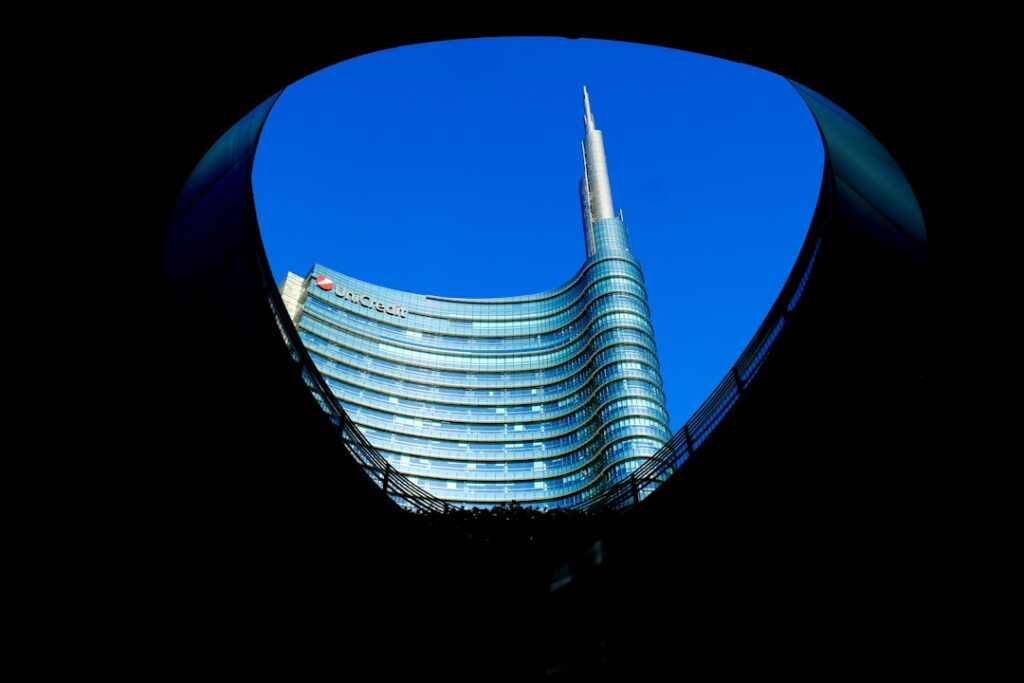
UniCredit Tower — located at Piazza Gae Aulenti, 4, 20154 Milano — is Italy’s tallest building (including its spire) and is notable for its slanted glass façade. Lobby access is open to the public; occasional guided tours and temporary exhibitions may be offered by the business center. The area is lively thanks to the shopping and restaurant level, generally open from 10:00 to 22:00. Costs: most public spaces are free, while paid events typically range from €5 to €25 depending on the occasion.
Practical tips: arrive by metro (M3 Repubblica or M2 Gioia), or by tram 9/33 depending on where you’re coming from. The best times to photograph Piazza Gae Aulenti are early morning (7:00–9:00) for soft light and fewer people, and at dusk for the lighting effects. Cafés around the square offer lunch deals from €8 to €20. For a high-end experience, book at the Ristorante in Piazza Gae Aulenti — à la carte prices are roughly €30–€60.

Bosco Verticale and Greening the Towers: Architecture Meets Biodiversity
The Bosco Verticale is an iconic residential sustainability project designed by Boeri Studio and located in the Porta Nuova area. The commonly cited address is Via Federico Confalonieri, 11, 20124 Milano (Isola/Porta Nuova sector). Two residential towers covered with trees and shrubs create a true vertical forest: more than 900 trees and thousands of bushes and plants on balconies and terraces. The effect is spectacular, especially in spring and summer when the green façade becomes a living ecosystem visible from Piazza Gae Aulenti.
Apartment access is private and not open for free visits, but you can admire the façades and sometimes join guided tours organized by local architectural tour operators. Practical info: the area is walkable from Isola station (metro M5) or reachable by tram 1/2. Guided tours run by specialist agencies typically cost between €15 and €30 per person and last 60–90 minutes. Photographers come early morning or late afternoon to capture the vegetation’s textures in low-angle light.
Practical tips: respect private property and avoid disturbing residents. To get the full picture, combine a visit to Bosco Verticale with a walk through the public spaces around Piazza Gae Aulenti and Via Giovanni Battista Pirelli, where other contemporary interventions can be seen. Wear comfortable shoes: the most scenic walking route starts from Stazione Garibaldi (Piazza Sigmund Freud), crosses Isola and heads up toward Porta Nuova in about 20–30 minutes.
 Click here to discover Milan’s highlights on a self-guided tour

Torre Velasca, Palazzo Lombardia and Architectural Memory
The Torre Velasca (Piazza Velasca, 1, 20122 Milano) is one of Milan’s most recognizable towers, built in the 1950s by BBPR. With its mushroom-like silhouette, it symbolizes the post-war reconstruction era and the dialogue between modernity and historic context. The building houses offices and some exhibition spaces. Lobby access is free during business hours; themed guided tours are occasionally organized by architectural history associations. Address: Piazza Velasca, 1, 20122 Milano. Typical visiting hours: 8:30–18:30 on weekdays (subject to internal events). Prices: lobby access is free, guided tours around €10–€15.
Palazzo Lombardia (Via Melchiorre Gioia, 37, 20124 Milano) is the seat of the Lombardy region and another focal point of the new administrative topography. Its panoramic terrace — sometimes open to the public — offers an unobstructed view of the city and the towers of Porta Nuova. General hours: the building operates on weekdays from 9:00 to 18:00, with public slots for the terrace according to the official schedule. Entry and exhibitions may be free or paid depending on events (temporary exhibitions between €0 and €12).
Practical tips: combine a visit to Torre Velasca with the Duomo and Galleria Vittorio Emanuele II to feel the contrast between historical eras. For Palazzo Lombardia, check terrace visiting times on the Regione Lombardia official website. Transport: metro M3 (Montenapoleone / Duomo) for Torre Velasca and M2/M3 to reach Palazzo Lombardia (Gioia / Garibaldi stations). For architectural photography, misty mornings and late afternoons create dramatic conditions to capture façades and silhouettes.
Click here to book your ticket for the cathedral and terraces
CityLife and the Tre Torri: A Multifunctional New Urban Landscape
The CityLife Milano development, located in the CityLife, Piazza Tre Torri, 20145 Milano neighborhood, is a large-scale redevelopment of the former Fieramilano exhibition grounds. It pairs three major towers — Torre Isozaki, Torre Generali (Allianz Tower) and Torre Hadid — with an extensive pedestrian area, the CityLife urban park and a shopping center (CityLife Shopping District). The shopping center sits on Viale Lizolo and offers shops, restaurants and a seasonal ice rink. Shopping center hours: generally 10:00–21:00, with some restaurants open later.
Walking among the Tre Torri gives an insightful read on contemporary verticality. The central square and green spaces are designed for a range of uses: jogging, kiosks, occasional markets and cultural events. Access to the office towers is usually restricted, but the park, Piazza Tre Torri and the shopping district are open to the public. Prices: parking and paid activities (ice rink, cinema) vary; restaurant menus range from €15 to €40.
Practical tips: the nearest metro stop is Tre Torri (M5 line). Allow at least 2 hours to explore the park, do some shopping and enjoy a coffee on a terrace. Families appreciate the playground in the park and the easy access to transport. For photographers, late afternoon light highlights the metallic and glass volumes of the towers. Check the CityLife events calendar if you want to attend an outdoor concert or exhibition.
Conclusion: Milan, an Urban Laboratory Balancing Verticality and Quality of Life
Milan shows that urban regeneration and tower construction don’t erase the city’s narrative: when planned holistically, verticality becomes a tool for social, landscape and architectural renewal. Examples like Porta Nuova, Bosco Verticale, Torre Velasca, Palazzo Lombardia and CityLife illustrate diverse approaches — densification, greening, memory preservation and creation of public spaces. These interventions have produced new walking routes, new squares and renewed cultural offerings, while also raising questions about accessibility, cost of living and the private-public relationship.
For visitors, the key is to combine architectural observation with local routines: get up early to photograph façades, favor public transport (metro M2/M3/M5), consult official sites for hours and book when necessary. The price ranges mentioned (guided entries €10–€30, meals €8–€60 depending on level) are rough guides: they fluctuate with season and events. Above all, the best way to understand modern Milan is to walk its new squares — Piazza Gae Aulenti, Piazza Tre Torri — sit in its cafés, listen to the echoes of past and ongoing works, and see how architecture dialogues with everyday life.
Whether you’re an architect, a curious traveler or a local, Milan offers a living route between towers and hanging gardens, between memory and innovation. Remember to respect private spaces, anticipate access controls and verify practical information before your visit. By following these addresses and tips, you’ll leave with a sharper understanding of Milan’s urban transformation and, perhaps, the urge to return to see how the city keeps evolving.