


Introduction: Skyscrapers and Heritage — Milan’s Living Contrast
Milan is a city of contrasts. As a capital of fashion and design, it blends Renaissance and Baroque heritage with bold urban modernity. Strolling through Milan means walking between the slim profiles of contemporary skyscrapers and façades aged by centuries of history: the pristine marble of the Duomo di Milano, the woodwork and gilding of the Teatro alla Scala, and the sturdy ramparts of the Castello Sforzesco sit alongside the glass volumes of Porta Nuova’s towers and the vertical greenery of the Bosco Verticale. Far from chaotic, this mix tells the story of a city that continuously reinvents itself without turning its back on the past.
Contenu de l'article
In this article we explore that contrast from several angles: architecture and emblematic sites, themed walks to watch the conversation between old and new, exact addresses and practical tips to make the most of your visit, plus anecdotes about how Milan integrates new symbols into its historic urban fabric. The goal is to give you an immersive, practical read: you’ll leave with full place names, exact addresses, up-to-date prices in euros, opening hours, and local tips to save time or find viewpoints that do justice to this unique blend.
The contrast in Milan is also visible in how the city manages public space: historic squares turned into stages for contemporary events, canal quays reshaped with a hipster-chic vibe, and former industrial districts recycled into cultural hubs. It’s not just about architecture but programming — exhibitions, markets, concerts, temporary installations — that animate both old and new places. We’ll also cover photo routes and observation points essential for capturing the beauty of medieval curves against the minimalist lines of glass and steel.
Finally, Milan offers a practical advantage for travelers: its compact urban density lets you move in minutes from a listed monument to a modern urban panorama. Whether you’re an amateur architect, photographer, foodie, or just curious, this contrast will speak to you. Bring comfortable walking shoes, a map or navigation app, and a credit card: some historic sites require reservations while others are free but crowded. We begin this guide by detailing the must-see places where the exchange between history and modernity is most striking.

1. The Historic Core: Duomo, Galleria and Teatro alla Scala — Classical Treasures at the Heart of Modernity
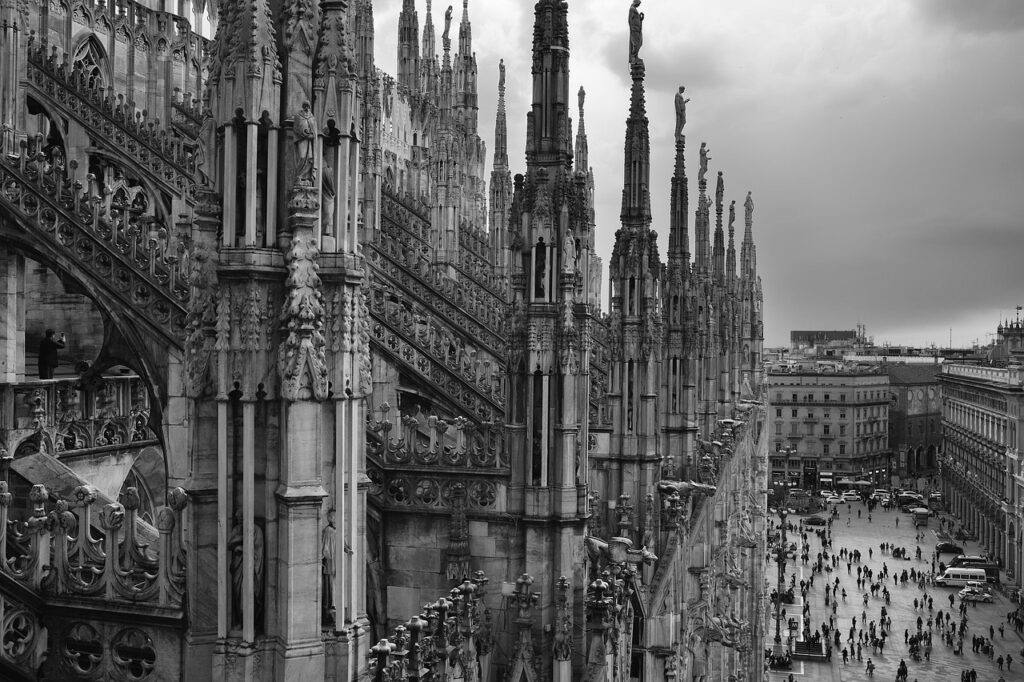
At the center of Milan, the Duomo – Galleria Vittorio Emanuele II – Teatro alla Scala axis is one of the best starting points to understand the city’s historical identity. The Duomo di Milano, officially the Cattedrale Metropolitana di Santa Maria Nascente, is located at Piazza del Duomo, 20122 Milano. This grand Gothic cathedral, with its marble façade and forest of pinnacles, offers a breathtaking spectacle. Prices and hours: the cathedral is generally open from 8:00 to 19:00; access to the cathedral can be free for mass, but visits to the museum, the complex and especially the panoramic terraces are paid. Expect around €15 to €20 for access to the terraces (including the lift) depending on the option chosen, and it’s highly recommended to buy a skip-the-line ticket online to avoid long queues.
Right next door, the Galleria Vittorio Emanuele II (Piazza del Duomo) is a 19th-century shopping arcade covered by a glass roof and decorated with mosaics. It houses luxury boutiques, historic cafés like Caffè Biffi and heritage restaurants. Entry is free, but watch the prices for coffee and chocolates: an espresso can cost between €2 and €6 depending on the spot. The Galleria is generally open from 10:00 to 20:00 for shopping arcades, while luxury stores may have extended hours.
Teatro alla Scala, at Via Filodrammatici, 2, 20121 Milano, is one of the world’s most prestigious opera houses. A visit to the Teatro alla Scala museum costs around €7 to €10 and the museum is usually open from 9:30 to 17:30 (closed on Mondays). Attending a performance often requires advance booking: ticket prices for an opera or ballet range from €20 to several hundred euros depending on the category.
Practical tips: visit the Duomo early in the morning (or late afternoon for the light) to avoid crowds. Book the terraces at sunset for magical views of the city and, on clear days, the Alps in the distance. For the Galleria, step away from the main arcades for a more reasonably priced coffee: explore adjacent streets like Via Santa Radegonda for small local pastry shops that are less touristy. Finally, if you plan to attend a La Scala performance, check for public rehearsals or guided tours of the theater to enrich your experience.
 Click here to book your ticket for the cathedral and its terraces
Click here to book your Skywalk ticket in the Galleria
Click here to book your ticket for the Teatro alla Scala museum

2. Porta Nuova and Bosco Verticale: Breathing Modernity
Porta Nuova is the most striking example of Milan’s urban renewal. At its heart lies Piazza Gae Aulenti, a modern esplanade surrounded by glass towers and public spaces. The UniCredit Tower gives its name to one of the area’s most recognizable addresses: Piazza Gae Aulenti, 10, 20154 Milano. Access to the piazza is free, and it’s an excellent observation point to photograph minimal lines and the urban layout. Shops and cafés in the area generally open from 8:00 to 20:00, while some restaurants stay open later.
Not far away, the Bosco Verticale (literally “Vertical Forest”) are two residential towers located approximately at Via Federico Confalonieri 28, 20124 Milano in the Isola/Porta Nuova neighborhood. Designed by architect Stefano Boeri (Boeri Studio), these towers are known for integrating vegetation on their façades — trees and shrubs planted on balconies that change the city skyline with the seasons. The apartments are private, but walking around the buildings lets you appreciate their visual impact. The best time to see them is in spring and summer when the greenery is lush. Early morning or evening are the most photogenic times to capture the foliage against the urban sky.
Hours and prices: Piazza Gae Aulenti and public spaces are open all day (24/7) but foot traffic decreases at night. For guided visits around Bosco Verticale, some local agencies offer architecture tours (prices around €15 to €30 per person, duration about 90 minutes). These tours explain the ecological strategy, planted biodiversity and the façade irrigation system. Book online in high season.
Practical tips: for good photos, position yourself on Corso Como to capture the perspective of the towers and the pedestrian promenade. Photographers should bring a wide-angle lens and a polarizing filter to manage reflections on glass. For a coffee with a view, try a spot around Piazza Gae Aulenti rather than the touristy Corso Como, for a more local vibe and moderate prices. Combine a visit to Porta Nuova with a stroll in Isola, where markets and small local shops remind you that Milanese modernity doesn’t exclude neighborhood charm.
3. Castello Sforzesco and the Streets of Historic Milan: Old Walls Facing New Volumes
Castello Sforzesco, located at Piazza Castello, 20121 Milano, is an impressive castle-museum that has served as a fortress, ducal residence, and administrative seat. Today it houses museums, art collections and exhibition spaces. Hours and prices: the castle and its museums generally open from 9:00 to 17:30 (closing times vary on Mondays), and the museum complex ticket costs around €5 to €10 depending on the exhibitions. Gardens and outdoor courtyards are free and offer picturesque views of towers and ramparts.
Walking from the Castello toward the Brera district, the atmosphere changes: cobbled lanes, artisan workshops and small squares slip between historic palaces and more recent buildings. The Pinacoteca di Brera, at Via Brera, 28, 20121 Milano, holds a precious collection of Italian art; entry usually costs around €10 and opening hours are typically 8:30 to 19:00 (closed on Mondays). This area exemplifies how Milan preserves its cultural institutions while keeping them lively with café terraces and contemporary galleries.
The contrast becomes obvious along the streets radiating from Piazza del Castello: on one side, Renaissance façades and gardens; on the other, modern buildings and discreetly integrated underground parking. Milanese urban designers have worked to make new volumes compatible with the human scale of these neighborhoods — using materials, colors and proportions that converse with the existing fabric. It’s a lesson in urbanism: modernity doesn’t always mean radical rupture, often it’s about composing.
Practical tips: allow at least half a day for this area if you want to visit Castello Sforzesco and the Pinacoteca di Brera. Buy tickets online to avoid queues, especially for popular temporary exhibitions. Cafés around Via Brera offer good lunch menus (average prices €12–€25); take the chance to try risotto alla Milanese (a regional dish) in a historic setting. For photography, golden hours (sunrise and sunset) produce warm light that brings out the ochre tones of the old stones.
Click here to buy your ticket for the Sforza Castle with audio guide
Click here to book your ticket for the Brera Pinacoteca
4. Walking Routes and Viewpoints: How to Read the City on Foot
The best way to sense the dialogue between skyscrapers and heritage is to follow walking routes that cross historic points and contemporary panoramas. Here’s a recommended route (2.5–4 hours depending on stops): start at Piazza del Duomo → Galleria Vittorio Emanuele II → Via Dante → Castello Sforzesco → Parco Sempione → Piazza Gae Aulenti (Porta Nuova). This itinerary moves through layers of history and offers several observation points: the Duomo forecourt for sculpted façades, the roofs of Castello Sforzesco for a close-up of the old town, then the transition to the verticality of Porta Nuova.
For a photo-focused variant, start early at the Duomo terraces for morning views, then head to the Ponte delle Sirenette near Parco Sempione to capture the juxtaposition of trees and towers in the background. Finish at Piazza Gae Aulenti at sunset for dramatic reflections on glass façades.
Practical walking tips: wear sturdy shoes (cobblestones and sidewalks can be uneven). Carry a small water bottle (tap water is drinkable), a map or GPS app, and consider museum passes if you plan to visit several sites (city passes can save time and money). If you travel in summer, begin early to avoid midday heat; in winter, pack warm clothes because the wind between towers can be sharp.
Access and mobility: Milan has an efficient public transport network (metro, tram, bus). A single metro ride costs about €2.20 (ticket singolo) and there are day and multi-day passes. To explore Porta Nuova and the historic core, the metro (lines M1, M3) and trams make connections easy. Bike-sharing (BikeMi) and electric scooters are also handy for short distances, but be mindful of traffic and pedestrian-only zones.

5. Contemporary Architecture and Regeneration: Case Studies and Top Spots
To round out your understanding of the contrast, it’s useful to look at a few contemporary urban regeneration projects. Beyond Porta Nuova, CityLife is a notable example. CityLife includes several towers (Torre Isozaki, Torre Hadid, Torre Libeskind) and a large public park. The central address for CityLife park is Piazza Tre Torri, 20145 Milano. Access to the park is free and it’s a prime place to see how open spaces and contemporary sculptures converse with the city. Temporary exhibitions and markets are frequent; check the local calendar to coincide with an event.
Another interesting case is the conversion of former industrial areas in Navigli and Tortona into creative hubs and galleries. The Navigli district runs along the canals, notably Via San Marco and Ripa di Porta Ticinese; it’s a place where the old turns contemporary with cafés, restaurants and artist studios in former warehouses. Summer evenings are particularly lively, with aperitivos typically costing around €10–€20 for a drink and buffet.
Practical tips and top picks: for contemporary architecture, book a guided tour of CityLife or Porta Nuova (prices around €15–€30) to better understand ecological and structural strategies. For a local immersion, dine in the Tortona district (Via Tortona) where restaurants and showrooms offer creative cuisine costing roughly €25–€50 per person depending on the place. If you want an overview, head up to the free belvedere at Palazzo Lombardia (Piazza Città di Lombardia, 1); access is often subject to specific opening times (check the schedule) but the platform delivers a remarkable panorama of Milan’s rooftops and skyscrapers.

Local Practical Tips and Safety
- Booking: for the Duomo terraces, The Last Supper (Cenacolo Vinciano) at Santa Maria delle Grazie, and performances at La Scala, book online several weeks ahead in high season.
- Opening hours: many museums close on Mondays; always check official websites before you go.
- Transport: a single metro ticket costs about €2.20, a day pass around €7. Taxis have a base fare plus per-kilometer charges; prefer official apps like MyTaxi or FreeNow.
- Safety: Milan is generally safe, but watch out for pickpockets in tourist-heavy areas (Duomo, Centrale station, Navigli).
- Meal times: lunch usually between 12:30 and 14:30, dinner often starting around 19:30; some restaurants close between 15:00 and 18:30.
Conclusion: A Lively Balance Between Past and Future
Milan tells a story of continuity and adaptation. Between skyscrapers and heritage, the city is not merely a collage of eras: it’s a laboratory where each contemporary intervention tries to establish a dialogue with what’s already there. From the Duomo di Milano (Piazza del Duomo, 20122 Milano) to the towers of Porta Nuova (Piazza Gae Aulenti, 10, 20154 Milano), via the vertical forests of Bosco Verticale (Via Federico Confalonieri 28, 20124 Milano) and the museums of Castello Sforzesco (Piazza Castello, 20121 Milano), each address shows a different strategy for urban integration.
On your trip, favor walking and cross-cutting routes to feel the transition between old and new: the shifting light, materials, uses of public spaces and the way residents inhabit places make the experience tangible. Book paid visits in advance (Duomo terraces, Teatro alla Scala museum, Last Supper replicas) and plan routes according to museum hours (many close on Mondays). For contemporary architecture lovers, guided tours of Porta Nuova and CityLife will give valuable insights; for atmosphere seekers, wander Brera, Navigli or Parco Sempione.
Finally, don’t miss the little local moments that make Milan so endearing: an espresso in the Galleria Vittorio Emanuele II (Piazza del Duomo), an aperitivo by the Navigli canals, or a break in a Brera café after visiting Castello Sforzesco. These moments reveal how a city can be both ceremonial and everyday, traditional and innovative. Milan teaches that living heritage knows how to renew itself, welcome new forms and invite visitors to read the city as an unfolding story. Enjoy your trip — and don’t forget your camera: Milan, seen from above or at street level, often looks even better than on a postcard.