





Introduction: Milan — where history meets modern verticality
Milan, the capital of Lombardy, is often associated with fashion, finance and an artistic heritage tied to the Duomo and The Last Supper. But since the 2000s, the city’s skyline has evolved with a wave of skyscrapers and towers that embody urban renewal and bold architecture. These buildings aren’t just economic symbols: they offer viewpoints, public spaces, hanging gardens and new urban experiences worth exploring for curious visitors.
In a city where old and new stand side by side, a handful of towers have become landmarks in their own right: the UniCredit Tower and Piazza Gae Aulenti, the Bosco Verticale with its planted façades, Palazzo Lombardia with its panoramic terrace, the Torre Diamante in the modern Porta Nuova quarter, and the Torre Velasca, a vestige of an earlier, controversial modernism. Each tells a different story — finance, biophilic design, regional government, post-industrial design — and offers a particular viewpoint over the Milanese metropolis.
This article offers a detailed tour of Milan’s most iconic skyscrapers. For each site you’ll find the full name, exact address, practical info (opening hours, prices), an immersive description of the building and its surroundings, plus local tips to make the most of your visit (best light, transport, nearby cafés or lodging, and safety notes). Whether you’re a photographer hunting unique angles, an architecture enthusiast, a curious traveler or a local looking to rediscover your city, this guide will help you plan concrete stops to observe, photograph and understand the towers shaping Milan’s skyline.
Before you head out, remember that some towers are office buildings or private residences: access can be restricted and vary by day or event. Bring ID if you plan to enter secure areas, check official sites for possible closures or re-openings, and respect residents’ privacy when photographing residential façades. Now lace up your walking shoes, pack your camera and curiosity — let’s explore Milan’s most iconic skyscrapers.
1. UniCredit Tower and Piazza Gae Aulenti: Porta Nuova’s showcase
Full name: UniCredit Tower (Torre UniCredit) and Piazza Gae Aulenti
Address: Piazza Gae Aulenti, 10, 20154 Milano MI, Italy
Access & price: Piazza Gae Aulenti is free to visit (open access). Ground-floor and rooftop bars and restaurants serve drinks; expect roughly €8–€18 for a coffee or cocktail. Some private guided tours inside the towers may cost between €10 and €25 depending on the itinerary and guide.
Opening hours: The square is accessible 24/7; shops and restaurants usually open from 9:00 to 23:00. The UniCredit building houses offices Monday to Friday, 9:00 to 18:00, with access control.
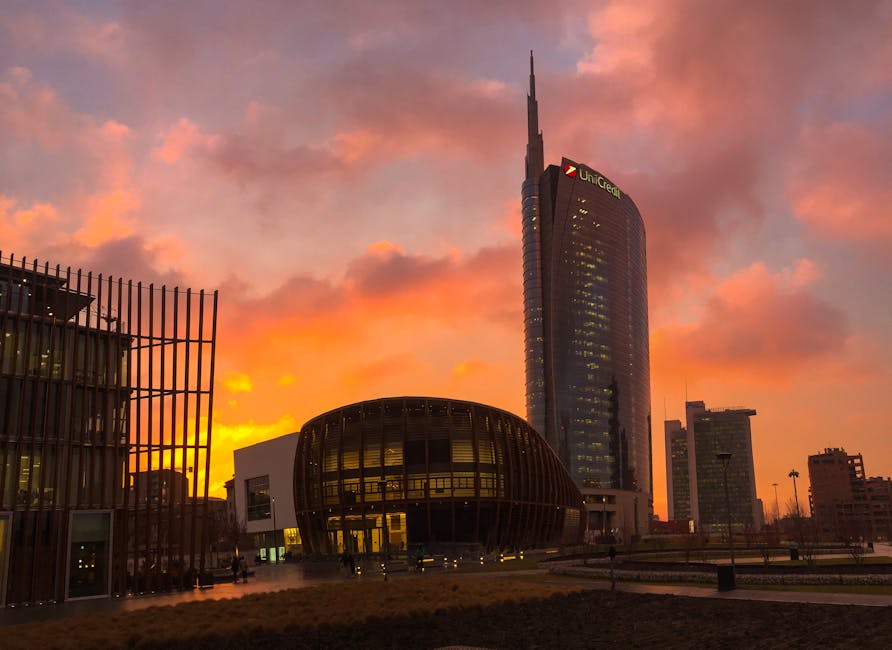
Designed by architect César Pelli, the UniCredit Tower is the tallest tower in Italy if you count its spire. It dominates the new Porta Nuova district, a contemporary urban area mixing offices, shops and public spaces. The big draw for visitors is Piazza Gae Aulenti, a raised circular plaza offering views of the tower and the nearby canal (Via Melchiorre Gioia). The glass façade mirrors the morning light and creates dynamic reflections with the sky and neighboring buildings.
For photography, arrive at sunrise or sunset: the glazed façade picks up pink and golden tones, and the square’s fountain adds movement to the foreground. Ground-floor bars and restaurants make convenient stops — buying a drink is an easy way to access private terraces with a view. The nearest metro stations are Garibaldi FS (lines M2 and M5) and, depending on where you come from, Pasteur; on foot, the square is about 10–15 minutes from Milano Centrale station.

2. Bosco Verticale: a vertical urban forest
Full name: Bosco Verticale (Residential Vertical Forest Towers)
Address: Via Federico Confalonieri, 11, 20124 Milano MI, Italy (Towers A and B, Porta Nuova/Isola neighborhood)
Access & price: The towers are private residences; interior access is reserved for residents. Viewing and photographing from the street is free. Occasional guided tours organized by agencies or the City Hall: €10–€20 (check availability).
Opening hours: Exterior views are possible 24/7; guided tours run at variable times (weekends are common) — book in advance.
Designed by Stefano Boeri, the Bosco Verticale is more than a skyscraper: it’s an ecological project where every balcony becomes a fragment of forest. The two towers — Torre A (taller) and Torre B — are literally covered with shrubs, trees and plants that filter CO2 and provide urban biodiversity. Street-level views (Via Confalonieri or Corso Como) are spectacular, especially in spring when the foliage thickens.
To feel the living nature of the project, stroll slowly around the towers, note the variety of planted species and observe how they integrate with Porta Nuova’s public spaces. Photographers will appreciate shooting in soft light; a wide-angle lens helps capture the vertical verde. Wear comfortable shoes — the neighborhood is full of cafés and small galleries where you can extend your visit. If you join an organized tour, ask about the botanical and technical explanations provided by the guides.

3. Torre Diamante (Diamond Tower) and the Piazza Gae Aulenti area
Full name: Torre Diamante (Diamond Tower) / Palazzo della Regione Lombardia – Porta Nuova commercial area
Address: Via Fabio Filzi, corner of Via Melchiorre Gioia, 20124 Milano MI, Italy
Access & price: The esplanade around the tower is open to the public; the interior is mainly offices. Some companies and business centers host visits or conferences: prices vary, often €0–€20 depending on the event.
Opening hours: Outdoor space accessible 24/7. Offices open during business hours: Monday–Friday 8:30–18:30.
Torre Diamante gets its nickname from an angular façade that catches the light like a gemstone. Located in Porta Nuova’s neo-modern core, it sits among the UniCredit Tower and other signature buildings. Its faceted silhouette creates multiple reflections and dynamic lines — perfect for geometric photographic compositions.
Walk across the forecourt, study the interplay of reflections between neighboring towers and use the perspectives offered by pedestrian walkways. The area is packed with modern cafés and small eateries — ideal for a break after shooting. For an elevated viewpoint, check nearby hotel rooftops (access permitting), which sometimes offer cocktails for €12–€20 with a view of the tower. At night, lighting emphasizes different materials and gives Torre Diamante an almost sculptural quality.
4. Palazzo Lombardia: the region’s panoramic terrace
Full name: Palazzo Lombardia (Headquarters of Lombardy Region)
Address: Piazza Città di Lombardia, 1, 20124 Milano MI, Italy
Access & price: The Panoramic Terrace (Belvedere) on the 39th floor is generally open to the public for free (subject to hours and security checks). Some temporary exhibitions may charge a small fee (€3–€8).
Opening hours: Terrace often open Monday to Friday, 8:30–18:30; weekends may open for special events. Check the Regione Lombardia official site for updated hours and closures.
Palazzo Lombardia is the regional headquarters and offers one of the most impressive public views of Milan’s skyline. From the panoramic terrace, on a clear day you can spot the Duomo on the horizon and the Alps in the distance. The rooftop walk is visitor-friendly: informational panels, benches and, seasonally, temporary exhibitions. Elevators bring you directly to the belvedere after an ID check if required.
Practical tips: arrive early to avoid groups and enjoy crisp morning light; late afternoon brings warm tones across the Duomo. Security checks can take a few minutes, so allow a buffer if you’re aiming for a specific time slot. Transport: « Garibaldi FS » station (M2/M5) or nearby tram lines depending on your route. Photographers will love the 360° views — bring a wide-angle lens and a windproof jacket if you plan to stay on the terrace as the sun sets.
5. Torre Velasca: historic modernism near the Duomo
Full name: Torre Velasca (Velasca Tower)
Address: Piazza Velasca, 20122 Milano MI, Italy
Access & price: The exterior and forecourt are freely accessible. Interior access is limited (offices and institutions); occasional guided tours or temporary exhibitions: variable fees €5–€15.
Opening hours: The forecourt is open 24/7. Interior access depends on events and office hours: generally Monday–Friday 9:00–18:00.
Built in the 1950s, Torre Velasca is one of the rare post-war skyscrapers that shaped Milan’s character. Its distinctive « hat » silhouette reflects an attempt to dialogue with Lombardy’s traditions while embracing modernity. Located near the Duomo and Teatro alla Scala, it offers a striking contrast between modern architecture and the historic façades of the city center.
To explore it, start at Piazza Velasca, study the bas-relief details and notice how the tower dominates the street without erasing the human scale. The area is full of trattorie, historic cafés and artisanal shops — perfect for extending your visit. Photographers should look for low-angle shots that emphasize the flared base and the shadow play beneath the « hat. » Finally, combine this stop with a walk to the Duomo: in 10–15 minutes on foot you can move from a modern symbol to the medieval heart of Milan.
 Click here to book your ticket for the Duomo and its terraces

General practical tips for visiting Milan’s skyscrapers
- Transport: use the metro (M2, M3, M5) and the tram network; the Porta Nuova area is very well served via Garibaldi FS.
- Best time: sunrise for calm photos; late afternoon for warm light; evening for illuminated façades.
- Gear: wide-angle lens, spare battery, windproof jacket for terraces, ID for secure access.
- Budget: many outdoor spaces are free; plan for €10–€25 for drinks or paid guided tours.
- Respect: some façades are residential — respect privacy and avoid pointing flashes directly at balconies.
Conclusion: between sky and street — why these towers are worth a visit
Milan’s iconic skyscrapers tell the story of a metropolis that keeps reinventing itself. From Torre Velasca’s historic modernism to Bosco Verticale’s ecological experiments, and the contemporary symbols of Porta Nuova like UniCredit Tower and Torre Diamante, each building offers a different reading of the city. Visiting these towers means observing the dialogue between public and private spaces, understanding recent urban planning choices and enjoying often surprising panoramas over historic neighborhoods.
Beyond architecture, these places are living spaces: bustling squares, cafés for a break, rooftop bars and planted promenades. Even when interior access is restricted, the quality of the public realm around the skyscrapers makes a visit rewarding; artworks, gardens and civic facilities turn each walk into a discovery. For photographer travelers, these buildings provide endlessly renewed motifs — reflections, vertical greenery, sharp angles — that constantly refresh how you see Milan.
Before you go, check official websites for updated hours and book guided tours if needed. Respect residents’ peace, look up temporary events (exhibitions, markets, concerts) that might enrich your visit, and take advantage of terraces and cafés to linger. Whether you spend half a day in Porta Nuova or tour the city pairing modern towers with the historic center, these skyscrapers will give you a fresh perspective on Milan in motion — vertical, vibrant and unmistakably contemporary.
