





Introduction
Milan, Italy’s economic capital and a cultural crossroads in the north, draws millions of visitors every year. Whether you’re here for fashion, architecture, or business, getting around the city matters. For wheelchair users, navigating a dense urban transport network can seem daunting at first — with platforms, stairs and historic trams — but Milan has made significant strides in recent years to improve accessibility on public transport. This article is a practical, detailed, hands-on guide to metro and tram accessibility in Milan, with concrete information: full place names, exact addresses, opening hours, prices in euros, descriptions, mental snapshots and local tips.
We cover both modern metro lines and older ones, the tram fleet — some models being fully low-floor — and the key stations equipped with elevators, ramps and assistance services. You’ll find precise details for must-see spots (Duomo di Milano, Castello Sforzesco, Milano Centrale), exact addresses, and time windows that help plan visits. The aim is to give you a clear, reliable picture: where to position your wheelchair, how to board and disembark safely, which tickets to buy, and who to contact if something goes wrong.
 Click here to book your ticket for Sforza Castle with audio guide
This guide is aimed both at first-time visitors planning a trip to Milan and residents seeking up-to-date info. It includes practical local tips — for example, which platforms to favor, how to use the ATM Milano app, where to find elevators outside busy hours, and how to combine metro and tram to reach the Navigli banks without surprises. As accessibility rules evolve, we recommend checking official contacts and opening times before you leave; nonetheless most information here is based on recent infrastructure and current ATM (Azienda Trasporti Milanesi) standards.
Throughout the article you’ll find visual cues to help you picture the places described — station façades, modern platforms, access ramps, urban views from accessible platforms — so you can plan routes with confidence. Whether you want to get to Piazza del Duomo, visit the Pinacoteca di Brera, or attend a trade fair at Rho Fiera, this detailed guide will help you move around Milan with greater autonomy and comfort.

Metro line accessibility: current state and practical tips
Milan’s metro network is made up of four main lines: M1 (red), M2 (green), M3 (yellow) and M5 (lilac). Each line has technical features and varying levels of accessibility depending on when stations were built and which upgrades have been completed. Here’s a clear, practical overview to help you choose wheelchair-friendly routes.
Line M5 (Lilac) — This is the newest and most accessible line in the network. Opened progressively since 2013, the M5 is an automated (driverless) line with raised platforms, step-free access via elevators and escalators, and a dedicated wheelchair area in every train. Typical hours: 06:00–00:30 (may vary by station and day). Key stations useful to visitors include Zara (Viale Zara 139, 20159 Milano) and Garibaldi FS (Piazza Sigmund Freud, 20124 Milano), both equipped with operational elevators. M5 trains are designed for passengers with reduced mobility, featuring wide doors and minimized gaps between platform and train.
Lines M1, M2 and M3 — These older lines show mixed accessibility. Some major stations have elevators and adapted access while others remain partially inaccessible. For example, Duomo station (Piazza del Duomo, 20122 Milano) has elevators connecting the surface to the M1 and M3 platforms; however, some transfer routes may require detours or using other accessible stations to make a barrier-free connection. Central hubs such as Cadorna FN (Piazza Luigi Cadorna, 20123 Milano) and Milano Centrale (Piazza Duca d’Aosta 1, 20124 Milano) have elevators and adaptive ramps.
Practical tip: before heading to a station, check ATM’s official accessibility map (available on atm.it or in the « ATM Milano » app). If an elevator is out of order, call ATM customer service at +39 02 486 17700 (hours vary; service in Italian/English) or go to the assistance point at major stations. Also remember metro hours are generally 06:00–00:30, with variations on holidays and during maintenance work.
Tram accessibility and stops: what to know before boarding
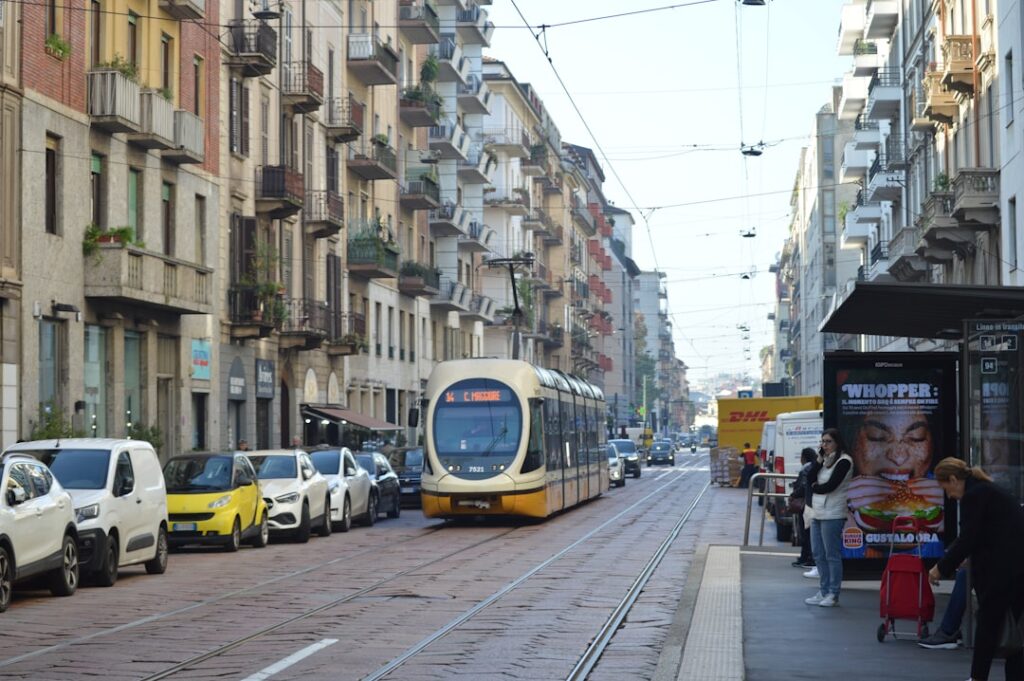
Milan’s trams are part of the city’s historic charm but can pose accessibility challenges. The fleet mixes old high-floor heritage trams (hard to access) with modern low-floor trams like the Sirio and Eurotram models, designed to ease boarding for wheelchair users. Stops with raised platforms (« a banchina ») allow level boarding when a low-floor tram serves the line.
Some tram lines are especially convenient: lines 2, 3, 9 and 15 tend to have a higher share of low-floor vehicles during daily rotations; however, access to a low-floor tram is not guaranteed every time. Lines serving tourist areas are often better equipped with modern vehicles. A practical example: line 2 connects Piazza Bausan (Via Bausan) to Piazza Negrelli and runs via Corso Buenos Aires — a useful route for getting to shopping areas with a reasonable chance of a low-floor tram.
Addresses and practical info:
- Piazza del Duomo (Piazza del Duomo, 20122 Milano) — Multiple tram and bus stops around the cathedral; be cautious of historic stops without raised platforms.
- Piazza Gae Aulenti (Piazza Gae Aulenti, 20154 Milano) — Modern area with adapted stops and straightforward routes to Garibaldi FS on the M5.
- Navigli (Alzaia Naviglio Grande) — Canal banks with tram stops nearby (access is often eased by temporary ramps at certain points).
Prices: ATM fares apply to trams as well — single urban ticket: €2.20 valid for 90 minutes; 24-hour ticket: €7.00; 48-hour: €12.00; 72-hour: €18.00. These tickets are valid on buses, trams and metro within the urban zone. Tickets can be bought at kiosks, station ticket machines, via the ATM app, or at participating retailers.
Practical tip: when you see a stop with a small raised platform and ramps, that’s a good sign — wait for that kind of stop to board. If you’re unsure whether the incoming tram is low-floor, ask the driver before the stop (there’s often an internal ramp) or wait for the next tram if you can.

Key accessible stations and available services
Here’s a selection of strategic stations and public places in Milan, with addresses, hours and descriptions of accessibility features. These hubs are useful reference points when planning your journeys.
Milano Centrale
Address: Piazza Duca d’Aosta 1, 20124 Milano.
Opening hours: Main concourse open 24/7; ticket offices and counters typically 06:00–23:00. Elevators and access ramps are available for platforms; there is an assistance point for disabled travelers at the main ticket desk. Large shops, luggage storage and cafés are accessible.
Description: Milano Centrale is not just a major rail station but also a metro interchange (M2 and several connections). Platforms have elevators and there are marked routes to exits. For a smooth trip, contact station assistance ahead of time if you need help boarding or transferring to an adapted taxi.

Duomo (Piazza del Duomo)
Address: Piazza del Duomo, 20122 Milano.
Hours: Station serves as an interchange between M1 and M3; metro hours 06:00–00:30. The Duomo di Milano (Cathedral) typically opens 09:00–19:00 (entrance and terrace opening times may vary). The Galleria Vittorio Emanuele II (Piazza del Duomo) is accessible and has step-free entrances on some sides.
Facilities: elevators to the surface, reserved spaces on trains, and an access ramp to the Museo del Duomo for wheelchair visitors. If you want to go up to the terraces, note that access may require an alternative route or a dedicated elevator; check at the Duomo ticket offices (Museo e Terrazze del Duomo, Piazza del Duomo) for procedures and prices. Indicative fares: cathedral visit from €3.00, terrace access between €7–€14 depending on option (elevator/stone stairs).
Click here to buy your ticket for the Duomo and accessible terrace
Garibaldi FS / Porta Garibaldi
Address: Piazza Sigmund Freud, 20124 Milano.
Hours: Station and interchange operate continuously for trains, metro and trams; elevators between surface and M2/M5 platforms are available during the day. The nearby Piazza Gae Aulenti area is fully flat and modern, making wheelchair movement easy.
Description: This area is ideal as a base to reach CityLife and Corso Como. Exits are wide, sidewalks ramped, and many businesses have accessible entrances. To reach the pedestrian area of Corso Como by wheelchair, use the station’s northeast exit and follow signs toward Piazza Gae Aulenti.
Rho Fiera Milano (Fiera Milano)
Address: Strada Statale del Sempione 28, 20017 Rho (MI).
Hours: Depends on events at the exhibition park; Rho Fiera station is normally open in coordination with fairs: platform access and elevators are available. For major events (Salone del Mobile, MIPEL, EICMA) the station and shuttle services are reinforced and assistance for people with reduced mobility is usually provided; contact the organizer to reserve specific help.
Tip: if you’re attending a fair, plan for peak crowds and book assistance in advance if needed. Regional tickets and shuttles can be reserved ahead; also allow extra time for entrance doors at the exhibition grounds.

Local practical tips for moving around confidently in a wheelchair
Getting around Milan in a wheelchair requires some preparation and local know-how. Here’s a thorough list of practical recommendations to help optimize your metro and tram trips.
- Plan routes with the ATM Milano app: it shows accessible stations and reports elevator outages. Download it (Android/iOS) and enable notifications.
- Check the accessibility map on atm.it or look for the printed map available at major stations. This map highlights adapted access points, escalators and elevators.
- Favor line M5 for cross-district travel: it’s fully accessible and makes transfers to Garibaldi FS and Zara easier.
- Think alternatives: accessible buses (equipped with ramps and a reserved space) can be direct solutions when a tram isn’t low-floor. Adapted taxis (radio taxi 0242 or specialized services) should be booked ahead.
- Tickets: buy a day pass (24h for €7.00) if you plan multiple trips — it avoids repeatedly validating separate tickets at machines.
- Check with attractions: museums and monuments (Duomo, Castello Sforzesco, Pinacoteca di Brera) often have dedicated access for visitors with reduced mobility. Example: Pinacoteca di Brera (Via Brera 28, 20121 Milano) usually opens 08:30–19:15, tickets around €12–€15; contact reception to reserve facilitated access.
- Safety: always respect the reserved spaces on trains and notify the driver if you need a ramp or extra time to board.
- Language and assistance: ATM offers customer service in Italian and English; for more personalized help, major hubs have assistance desks for people with reduced mobility.
Click here to book your ticket for the Pinacoteca di Brera

Finally, remember the urban environment can be variable: historic cobbles around the cathedral, narrow sidewalks in some neighborhoods, and occasional construction works. Carry a small toolkit (straps, seat protectors) if you travel with an electric wheelchair, and don’t hesitate to ask shopkeepers or ATM staff for help — they’re generally willing and helpful.
Conclusion
Milan is not just a destination for style and business: it’s also a city that’s evolving to become more accessible. Thanks to recent investments, line M5 offers exemplary comfort for travel, and many major stations (Milano Centrale, Duomo, Garibaldi FS, Rho Fiera) have been adapted to meet the needs of wheelchair users. Modern low-floor trams improve options, although the mixed fleet means caution and planning are sometimes necessary.
This guide has given you concrete information: addresses (Piazza Duca d’Aosta 1 for Milano Centrale, Piazza del Duomo for the cathedral, Piazza Sigmund Freud for Garibaldi FS, Strada Statale del Sempione 28 for Rho Fiera), fares (single urban ticket €2.20, 24h €7.00, 48h €12.00, 72h €18.00), general metro hours (around 06:00–00:30) and practical advice for transfers, boarding trams and booking assistance. These details will help you design safe, pleasant routes from the modern avenues of Porta Nuova to the historic banks of the Navigli.
To finish, a few final recommendations and points of caution: contact ATM in advance if you have specific needs, use the ATM Milano app and accessibility maps, favor line M5 and accessible buses when in doubt, and be mindful of local street conditions (cobbles, works). Milan offers a rich array of experiences — cultural visits, shopping and food walks — that become accessible with adequate preparation. With these tips and by using adapted stations and lines, you’ll be able to explore the city confidently and enjoy its unique energy.